Packaging and Transport Guidelines for EPS and GPPS
2025-11-18
Future of Polystyrene in a Circular Economy
2025-11-22
The Role of Styrene Monomer in GPPS Production
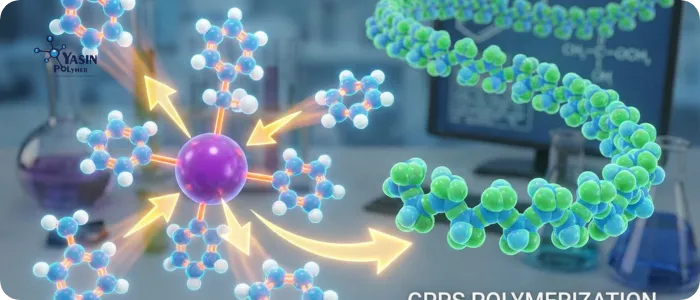
Styrene Monomer (SM) is the primary liquid feedstock derived from benzene and ethylene, serving as the essential building block for General Purpose Polystyrene (GPPS). Through a process called polymerization, the carbon-carbon double bonds in the styrene molecule break to form long, rigid, and transparent polymer chains that constitute GPPS.
While polymerization is standard science, the purity of the styrene monomer is what dictates the market value of the final plastic. Even trace impurities or improper inhibitor management can turn a crystal-clear batch into a yellowed, brittle waste product. Below, we reveal how to control these variables to ensure high-grade output.
What Is Styrene Monomer and Why Is It Vital for GPPS
Defining Styrene Monomer in the Context of Polystyrene
Styrene Monomer is an organic compound with the chemical formula $C_8H_8$. In the context of plastics manufacturing, it acts as the “monomer” the single unit that bonds together to create the “polymer,” or many units. It is a derivative of downstream petroleum processing, specifically produced through the dehydrogenation of ethylbenzene. Without this specific aromatic hydrocarbon, the creation of polystyrene is chemically impossible.
Key Chemical Properties of Styrene That Define GPPS
The physical characteristics of the final plastic are directly inherited from the properties of the monomer itself:
-
Refractive Index: Styrene possesses a high refractive index (approx. 1.54), which is responsible for the glass-like clarity and sparkling appearance of GPPS.
-
Rigidity: The presence of the benzene ring in the styrene structure provides the polymer with exceptional stiffness and dimensional stability.
-
Boiling Point: With a boiling point of roughly 145°C, the monomer remains liquid at room temperature but requires careful thermal management during processing to initiate reaction without degradation.
The Supply Chain from Crude Oil to Styrene and GPPS
To understand the cost and quality of GPPS, one must understand the flow of its ingredients. The process begins with Crude Oil, which is refined into Naphtha. Through cracking, Naphtha yields Benzene and Ethylene. These two petrochemicals are combined to form Ethylbenzene, which is then dehydrogenated to produce the Styrene Monomer. Finally, this monomer is fed into reactors to synthesize GPPS. This linear dependency means any fluctuation in crude oil quality or price impacts the final polystyrene product immediately.

How Styrene Monomer Transforms into General Purpose Polystyrene
Understanding the Polymerization Process of Styrene
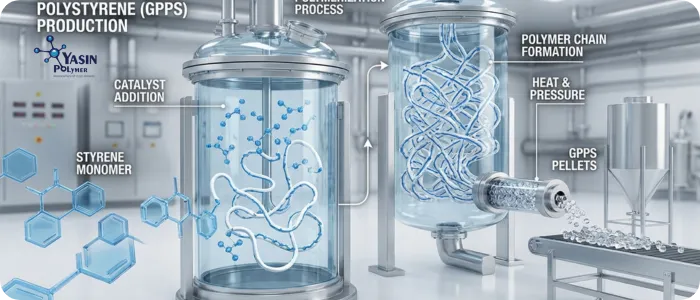
The transformation from liquid monomer to solid plastic occurs via Free Radical Polymerization. This mechanism typically uses Initiators, such as organic peroxides, which break down under heat to create free radicals that attack the double bond of the styrene. This opens the bond and allows it to link with another styrene molecule, starting a chain reaction. Crucially, this is an exothermic reaction (it releases heat). Efficient heat dissipation is required to prevent runaways and ensure a consistent product.
Difference Between Bulk and Suspension Polymerization for GPPS
Manufacturers choose their polymerization method based on the desired end-application of the GPPS.
| Feature | Bulk Polymerization Process | Suspension Polymerization Process |
| Purity | Extremely high purity; no water or suspension agents involved. | Lower purity due to potential residues from suspension agents. |
| Clarity | Excellent optical properties; ideal for premium packaging. | Good clarity, but risks “haze” from water contamination. |
| Processing | Continuous process; highly efficient for large volumes. | Batch process; allows for easier heat control but requires drying. |
| Key Use | Food packaging, optical sheets, refrigerator trays. | Expanded Polystyrene (EPS) beads or lower-grade GPPS. |
The Role of Heat and Catalysts in Styrene Conversion
Temperature control acts as the throttle and brake for the reaction. The temperature profile must be ramped up carefully to maintain a steady conversion rate. If the heat is too low, the reaction stalls; if it is too high, the polymer chains terminate too early, resulting in weak plastic.
Pro Tip: Maintaining the correct temperature profile is critical not just for safety, but to control the Molecular Weight Distribution (MWD). A consistent MWD ensures that the GPPS grade meets specific flow and strength requirements, preventing “runaway reactions” that ruin the reactor batch.
How Styrene Monomer Affects GPPS Quality and Performance
Why Styrene Gives GPPS High Transparency and Clarity
GPPS is prized for being as clear as glass. This is due to the “amorphous” structure of the polymer chains. Because the large benzene rings attached to the styrene backbone are bulky, the chains cannot pack together tightly into a crystal lattice. Instead, they remain in a disordered, random state. This lack of crystallization allows light to pass through the material unobstructed. “Haze formation” occurs when this structure is disrupted by impurities or incorrect cooling.
The Link Between Styrene Purity and GPPS Discoloration
The clarity of GPPS is fragile. Even microscopic contaminants in the styrene monomer feed can cause significant discoloration:
-
TBC (Tertiary Butyl Catechol): This is an inhibitor added to styrene to prevent it from polymerizing during storage. However, it must be removed or neutralized before the reactor. If TBC remains, it oxidizes and turns the final plastic yellow.
-
Sulfur and Chlorides: These impurities, often from low-quality feedstock, scatter light and ruin the optical properties.
-
Oxidation Products: Aldehydes and ketones formed from improperly stored styrene will cause color shifts, turning the clear plastic into a dull, straw-colored product.
Impact of Styrene Monomer on Rigidity and Brittleness
Styrene makes GPPS stiff, but also brittle. This is due to “steric hindrance.” The bulky benzene rings restrict the movement of the polymer chains, making the material hard and resistant to deformation. However, this rigidity means the material cannot absorb much energy upon impact, causing it to crack easily. The degree of polymerization controlled by the purity and feed rate of the monomer determines the balance between necessary stiffness and unwanted brittleness.
Understanding Molecular Weight Distribution in Styrene Chains
The performance of GPPS in molding machines is defined by its Melt Flow Index (MFI), which is a direct result of the Molecular Weight Distribution.
-
High Molecular Weight: Occurs when long styrene chains are formed. The plastic is stronger but harder to melt and process.
- Low Molecular Weight: Occurs with shorter chains. The plastic flows easily (High MFI) but is physically weaker.The quality of the initial Styrene Monomer feed influences how precisely a manufacturer can control this distribution.
Managing Residual Styrene Monomer in GPPS Production
What Is Residual Styrene Monomer and Why It Matters
Residual Monomer refers to the tiny percentage of styrene liquid that fails to react and becomes trapped inside the solid plastic matrix. In the world of GPPS, the level of residual monomer is the single biggest quality indicator, especially for food-contact grades. High residuals indicate an inefficient polymerization process and a lower-quality product.
How Residual Styrene Affects Smell and Safety of GPPS
From a user experience perspective, high residual styrene is unmistakable. It emits a distinct, sharp, solvent-like chemical smell. The primary safety concern is “Migration” the process where unreacted styrene moves from the plastic container into hot food or beverages. Because styrene is considered a potential carcinogen in large quantities, this migration is a major safety compliance issue.
Techniques to Reduce Residual Monomer Levels in Manufacturing
-
Optimizing Devolatilization: The final stage of production involves passing the molten polymer through a vacuum chamber (devolatilizer) to strip out unreacted styrene and recycle it.
-
High-Temperature Initiators: Using specific peroxides that activate at higher temperatures helps push the conversion rate closer to 99.9% in the final reactor stages.
-
Scavenging Agents: In some advanced processes, chemical scavengers are used to react with the last remaining traces of monomer, though this is less common in standard GPPS.
Regulatory Limits for Styrene Monomer in Food Contact GPPS
Manufacturers must adhere to strict standards such as FDA CFR 21 and EU Regulation No 10/2011. These regulations do not ban styrene but limit how much creates a risk of migration. General industry standards for high-quality food-grade GPPS require residual monomer levels to be below specific thresholds, typically less than 500 ppm (parts per million).

Economic and Environmental Aspects of Styrene in GPPS
How Styrene Monomer Prices Impact GPPS Manufacturing Costs
There is a direct correlation between the barrel price of oil and the cost of a clear plastic cup. Since styrene is a commodity strictly linked to benzene and ethylene prices, GPPS pricing is inherently volatile. Furthermore, inventory management is a hidden cost factor; styrene monomer has a limited shelf life. If stored too long, it begins to self-polymerize, turning valuable feedstock into unusable sludge.
The Rise of Bio Attributed Styrene for Sustainable GPPS
The industry is moving toward the “Mass Balance” approach. This involves using bio-naphtha (from tall oil or waste fats) or recycled feedstock to create “Green Styrene.” This material is chemically identical to fossil-based styrene meaning no changes to the GPPS machinery are needed but it carries a significantly lower carbon footprint.
Recycling GPPS Back into Styrene Monomer
Polystyrene offers a unique advantage in the circular economy: Chemical Recycling. Unlike many plastics that degrade when recycled, GPPS can be subjected to depolymerization (using heat and no oxygen) to break the chains back down into their original Styrene Monomer form. This recycled monomer has high purity and can be used to make virgin-quality GPPS again, closing the loop completely.
Conclusion:
Styrene Monomer plays a decisive role in GPPS production, shaping both the chemical structure and the performance of the final plastic. From monomer purity and inhibitor control to temperature management, polymerization method, and residual styrene removal, every step directly influences clarity, rigidity, safety, and overall product value. When manufacturers effectively manage these variables—from the petrochemical supply chain to the final devolatilization stage—they can produce high-quality GPPS with excellent optical properties, stable processing behavior, and full compliance with demanding industrial and food-contact standards.
Frequently Asked Questions About Styrene in GPPS
Is Styrene Monomer Toxic in Finished GPPS Products?
Styrene monomer itself is a volatile liquid with health concerns, but polymerized GPPS is considered safe, stable, and inert. The health risk lies only in the migration of residual unreacted monomer, which is why strict regulatory limits are enforced on food-contact plastics.
Can Impure Styrene Monomer Be Used for GPPS?
No. High-quality GPPS requires polymerization-grade styrene, typically with a purity of 99.7% or higher. Using impure monomer leads to haze, yellowing, and processing instability, rendering the final product unsellable for optical or food-packaging applications.
What Is the Ideal Storage Temperature for Styrene Monomer?
Styrene monomer should be stored in a cool environment, typically below 25°C (77°F), and constantly monitored for TBC (inhibitor) levels. High temperatures accelerate self-polymerization, which can damage storage tanks through heat buildup and degrade the feedstock quality before it even reaches the processor.