How to Ensure Consistent Quality in Recycled Polystyrene
The single biggest barrier to selling recycled Polystyrene (rPS) at a premium price is not material availability, but quality variance. To successfully substitute virgin material and protect your profit margins, you must master the delicate operational balance required for this polymer. This guide provides the critical technical steps to stabilize your output, from feedstock sorting to final extrusion, ensuring your rPS meets the rigorous demands of molders.
Why is Recycled Polystyrene Quality Control Difficult?
Polystyrene ($(C_8H_8)_n$) presents unique challenges compared to polyolefins due to its specific chemical structure. Understanding these vulnerabilities is the first step to mitigating production failures.
- Thermal Degradation: Unlike PE or PP, Polystyrene is highly sensitive to UV exposure and heat. Excessive thermal history causes the polymer chains to break rapidly, leading to yellowing and a significant loss of mechanical strength.
- The Memory Effect: PS retains a “processing history.” Every time it is melted, it degrades slightly. If your feedstock has already been recycled multiple times, its structural integrity is compromised before it even enters your extruder.
- Mixed Streams: The chemical incompatibility between Expanded Polystyrene (EPS) and Crystal Polystyrene (GPPS) means even slight cross-contamination can result in material that is too brittle for industrial use.
Factors Affecting Recycled Polystyrene Consistency
Identifying the root cause of inconsistency allows you to target your quality control efforts effectively.
- Feedstock Variability: This is the most overlooked factor. Mixing post-consumer packaging (often contaminated with food) with construction insulation (containing flame retardants) creates unpredictable melt behaviors.
- Process Instability: Polystyrene requires a narrow processing window. Minor fluctuations in extruder temperature or screw speed can instantly degrade the material’s properties.
- Polymer Contamination: PS has zero tolerance for cross-contamination. Even trace amounts of labels, glues, or stray Polypropylene (PP) will cause delamination in the final product.
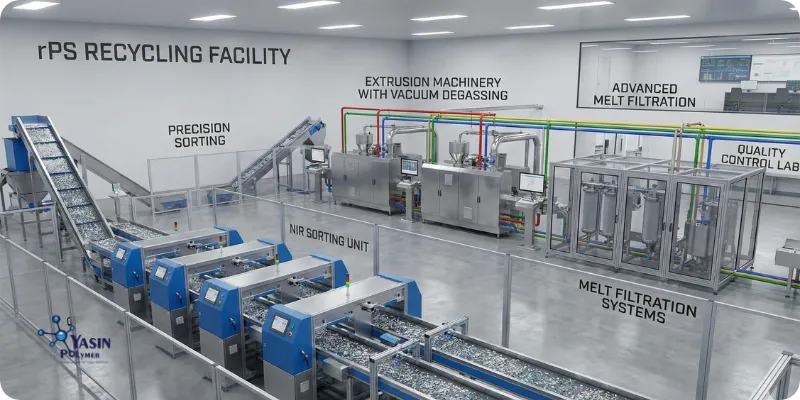
Importance of Feedstock Sorting and Cleaning
You cannot fix poor input with good extrusion; effective sorting is your primary line of defense against quality failure.
- NIR Sorting: Manual sorting is insufficient for high-volume lines. Near-Infrared (NIR) technology is mandatory to automate the separation of polymers, ensuring that non-PS materials are ejected before processing.
- HIPS vs. GPPS Separation: This is critical. High Impact Polystyrene (HIPS) contains butadiene rubber for toughness, while General Purpose Polystyrene (GPPS) is rigid and clear. Mixing these two destroys the impact strength of the HIPS and the clarity of the GPPS, rendering the batch unusable for specific applications.
- Density Separation: Implementing sink-float tanks allows for the efficient removal of heavy contaminants and metals that could damage downstream machinery.
Optimizing the Extrusion Process for Polystyrene
Operators often make the mistake of treating PS like Polyethylene, using aggressive settings that ruin the polymer. Precise machine parameters are required to prevent degradation.
- Vacuum Degassing: This is non-negotiable for rPS. You must ensure high-efficiency degassing zones are active to strip volatile monomers, moisture, and residual odors that cause bubbles in the final pellet.
- Shear Stress: Use low-shear screw designs. High shear rates generate excessive frictional heat, which snaps the polymer chains and reduces the material’s viscosity uncontrollably.
- Temperature Profiles: Maintain a strict temperature profile. Overheating to increase flow rate is a common error that results in immediate yellowing and brittleness.
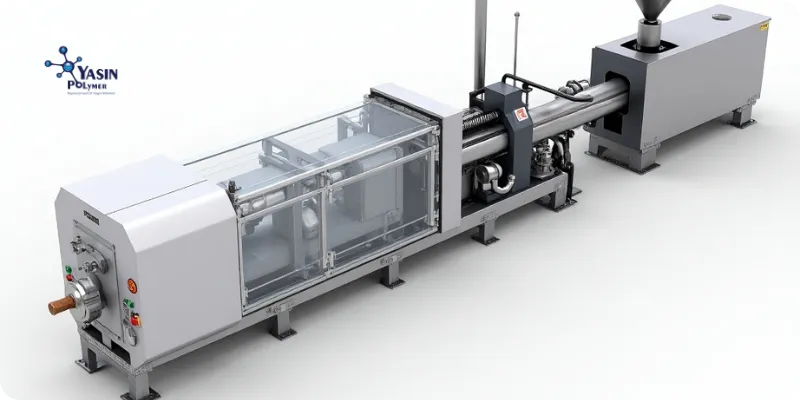
Role of Melt Filtration in Contaminant Removal
To achieve a product that competes with virgin resin, your filtration hardware must be robust.
We recommend utilizing Laser Filters or continuous screen changers to handle the specific contamination load of rPS. For high-quality output suitable for thin-wall injection molding, a filtration fineness of 100 to 150 microns is the standard. This level of filtration is essential to remove microscopic “specks” (burnt paper, aluminum, or rubber) that cause aesthetic defects and structural weak points in the final product.
Managing Melt Flow Index (MFI) Stability
Fluctuating flow rates are the primary complaint from buyers, as they disrupt injection molding cycles. Stabilizing MFI is the mark of a professional recycling operation.
Homogenization
You cannot rely on the extruder alone to mix the material. The use of Homogenization Silos after pelletizing is mandatory. By blending large batches of pellets in a vertical silo, you average out the variations, ensuring the client receives a uniform MFI throughout the entire truckload.
Additives
If the recycled plastic has degraded and the MFI is too high (too runny), chain extenders can be introduced during extrusion. These additives reconnect broken polymer chains, effectively lowering the MFI and restoring the material’s viscosity to a usable range.

Essential Testing Standards for Recycled Polystyrene
To certify your material for sale, your lab must utilize these specific international standards:
- ASTM D1238: Determines the Melt Flow Rate (MFR), the most critical data point for molders.
- ISO 178: Measures Flexural Properties, indicating how much the material can bend before breaking.
- Charpy or Izod Impact Tests: essential for HIPS, these tests quantify the material’s brittleness and impact resistance.
Advanced Technologies for High-Purity rPS
For applications requiring near-virgin quality or food-contact compliance, mechanical recycling has limits that only advanced technology can surpass.
- Solvent-based Purification: This technique uses specific solvents to dissolve the Polystyrene, allowing for filtration at a molecular level to remove additives and pigments (Dissolution).
- Depolymerization: This chemical recycling method breaks PS down into its building block, Styrene Monomer. It is currently the only viable pathway to achieve genuine Food-Contact rPS status, as it resets the material history completely.

Common Quality Defects and Troubleshooting
Use this quick reference guide to identify and resolve production issues immediately on the shop floor.
| Defect |
Probable Cause |
Quick Solution |
| Black Specks |
Dirty screens or screw degradation |
Change screens immediately; purge extruder to clean carbon buildup. |
| Bubbles in Pellets |
Moisture or Volatiles |
Check vacuum degassing pressure and seal integrity. |
| Yellowing |
Overheating or High Shear |
Reduce barrel temperature profiles or lower screw RPM to reduce shear heat. |
Conclusion
Achieving consistent, high-quality recycled Polystyrene is less about equipment size and more about discipline across every stage—from precise feedstock separation to controlled extrusion and rigorous testing. When sorting accuracy, thermal stability, filtration quality, and MFI management work in harmony, rPS can reliably replace virgin PS in demanding applications. This operational consistency not only protects your profit margins but also positions your recycled material as a premium, trusted product in the market.
FAQs
1. Why does recycled Polystyrene show more quality variation than other recycled polymers?
Because Polystyrene is highly sensitive to heat, UV exposure, and repeated processing cycles, its molecular chains degrade faster than those in materials like PE or PP. This makes rPS much more vulnerable to yellowing, brittleness, and inconsistent melt behavior if feedstock and processing parameters are not tightly controlled.
2. How can I prevent cross-contamination between HIPS, GPPS, and other polymers?
You must rely on automated sorting systems—especially NIR sorting—to eliminate non-PS materials. Additionally, separate HIPS and GPPS streams at the sorting stage, since mixing them compromises impact strength, clarity, and downstream processability.
3. What extrusion parameters are most critical for stabilizing rPS quality?
Maintain a narrow and stable temperature profile, use low-shear screw designs, and ensure high-efficiency vacuum degassing. These prevent thermal degradation, remove volatiles that cause bubbles, and help preserve polymer viscosity. Even small fluctuations in temperature or screw speed can cause immediate drops in mechanical properties.
4. How can I keep Melt Flow Index (MFI) consistent across large production batches?
Use homogenization silos after pelletizing to blend pellets from different runs and eliminate batch-to-batch variation. If the material has degraded and the MFI is too high, introduce chain extenders to rebuild polymer chains and restore the target viscosity.