Conclusion
Effective quality control for EPS and GPPS isn’t just about running tests it’s about understanding what each material demands and translating laboratory data into stable, efficient production. By monitoring the right parameters Pentane levels and bead uniformity in EPS, and optical properties and MFI consistency in GPPS manufacturers can prevent costly defects, maintain predictable processing behavior, and deliver products that consistently meet performance and safety standards. When QC teams apply these tests with discipline, they turn potential production risks into competitive advantages.



Lifecycle Assessment (LCA) of GPPS and EPS Materials
2025-12-03
How to Ensure Consistent Quality in Recycled Polystyrene
2025-12-10Quality Control Tests for EPS and GPPS Granules
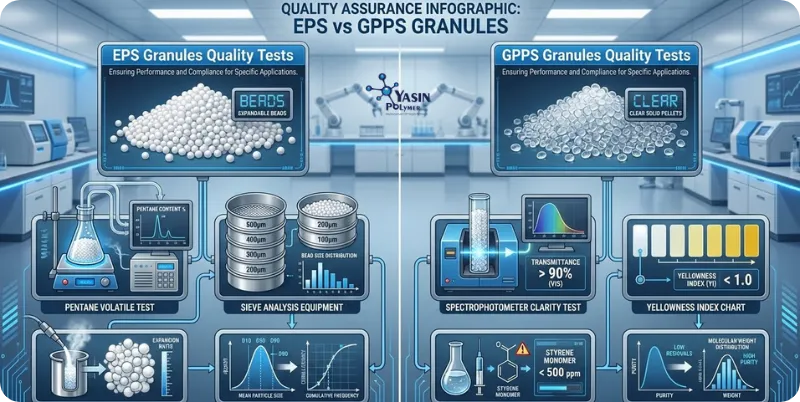
EPS (Expandable Polystyrene) and GPPS (General Purpose Polystyrene) require fundamentally different testing protocols. While Melt Flow Index (MFI) is crucial for both, EPS quality relies heavily on Pentane retention and bead size distribution, whereas GPPS quality is defined by optical clarity and yellowness index. Ignoring these distinct parameters leads to production downtime and product rejection.
Why is Quality Control Important?
In the petrochemical and plastics processing industry, Quality Control (QC) is not just a regulatory checkbox; it is the primary defense against profit loss. From our experience on the production floor, a slight deviation in granule consistency can stop high-speed injection molding machines or cause structural failure in insulation blocks.
Effective QC ensures:
-
Process Stability: Prevents machine clogging or erratic cycle times.
-
Cost Reduction: Minimizes scrap rates and energy waste from reprocessing bad batches.
-
Customer Retention: Ensures the final product (whether a disposable cup or a building block) meets performance specs every time.
What is the Difference Between EPS and GPPS?
To test correctly, you must understand the material’s nature.
-
EPS (Expandable Polystyrene): These granules contain a blowing agent (usually Pentane). They are designed to expand. The critical quality factor here is the “potential to expand” and the “uniformity of the cell structure.”
-
GPPS (General Purpose Polystyrene): These are solid, crystal-clear pellets. They do not expand. The critical quality factors here are “transparency,” “rigidity,” and “flow.”
Key Quality Control Tests for EPS
Since EPS is a “living” material that changes with time (due to gas loss), testing must focus on its expansion capability and bead geometry.
-
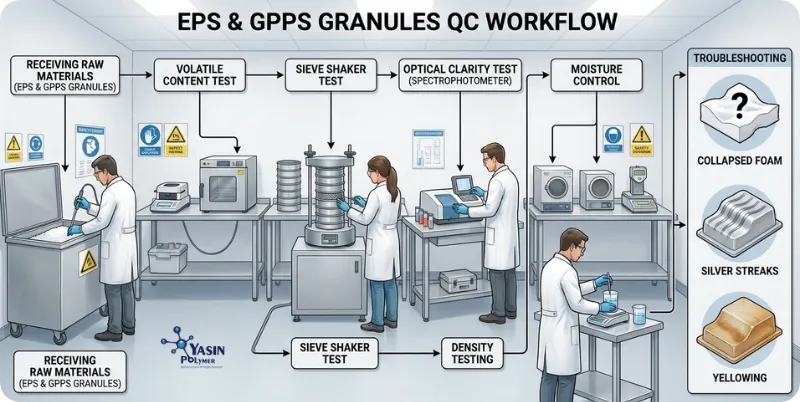
Volatile Content (Pentane Check): This is the most critical test. If Pentane levels drop below 5-6%, the beads will not expand properly, leading to “dead beads” or shrinkage. Pro Tip: Always test EPS immediately upon delivery, as improper storage (heat) causes gas loss.
-
Sieve Analysis (Bead Size Distribution): Using a sieve shaker, we determine the percentage of beads in each size range. Uniform bead size is vital for uniform density in the final block. Mixed sizes result in air pockets and weak structural integrity.
-
Expansion Ratio: A practical test where a known weight of beads is expanded in a steam bath to measure the volume achievement. This predicts the material’s yield.
Key Quality Control Tests for GPPS
For General Purpose Polystyrene, the focus shifts to aesthetics and processing behavior.
-
Optical Clarity and Haze: GPPS is prized for its glass-like clarity. We use a spectrophotometer to measure Transmittance (light passing through) and Haze (light scattering). High haze indicates contamination or poor polymerization.
-
Yellowness Index: A common defect in GPPS. A high Yellowness Index usually indicates thermal degradation during manufacturing or the presence of impurities. This ruins the material for clear packaging applications.
-
Residual Monomer: High levels of residual Styrene monomer can cause a strong chemical smell and pose health risks, especially in food contact applications.

What is Melt Flow Index Testing?
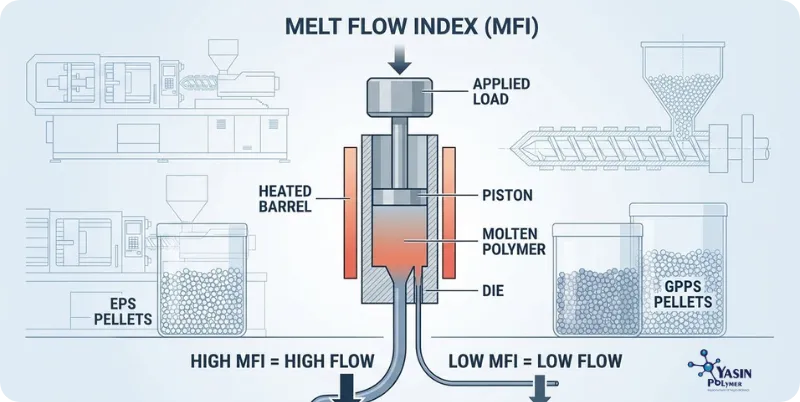
Melt Flow Index (MFI) is the universal language of thermoplastics. It measures how easily the polymer flows when melted.
How it works:
A specific weight (load) forces the melted plastic through a tiny die for 10 minutes. The weight of the extruded plastic is the MFI value.
-
Why it matters:
-
High MFI: Material flows like water. Good for filling complex, thin-walled molds (like cutlery).
-
Low MFI: Material flows like honey. Good for extrusion and strong parts, but harder to process.
-
Troubleshooting: If your MFI fluctuates between batches, your injection pressure settings will fail, causing short shots (incomplete parts) or flash (excess material).
-
Important ASTM and ISO Standards
Reliable QC relies on global standards. Use this reference table for your lab protocols:
| Test Parameter | ASTM Standard | ISO Standard | Application |
| Melt Flow Index (MFI) | ASTM D1238 | ISO 1133 | EPS & GPPS |
| Density | ASTM D792 | ISO 1183 | GPPS (Solid) |
| Apparent Density | ASTM D1622 | ISO 60 | EPS (Beads) |
| Vicat Softening Point | ASTM D1525 | ISO 306 | GPPS (Heat resistance) |
| Tensile Strength | ASTM D638 | ISO 527 | GPPS (Mechanical) |
| Volatile Matter | ASTM D2360 | — | EPS (Gas content) |
Essential Laboratory Equipment
You don’t need a university research center, but a functional industrial QC lab must have:
-
Melt Flow Indexer (Plastometer): The workhorse of the lab.
-
Analytical Balance: Precise to 0.0001g for density checks.
-
Laboratory Oven: For moisture analysis and drying tests.
-
Sieve Shaker: Essential for EPS classification.
-
Spectrophotometer: For GPPS color and haze analysis.
How Does Moisture Affect Granules?
Moisture is the silent killer in polystyrene processing.
-
In GPPS: Even 0.1% moisture turns into steam inside the injection barrel. This creates Silver Streaks (Splay Marks) on the surface of the clear part, rendering it scrap. Recommendation: Always dry GPPS at 70-80°C for 2-3 hours before processing if the bag seal is compromised.
-
In EPS: While steam is used to expand EPS, the raw beads must be kept dry. Wet surface beads can clump together during pre-expansion, clogging the feed lines.
Common Defects and Troubleshooting
Connecting lab data to real-world problems is where a QC manager adds value.
| Defect Observed | Likely Cause | Lab Check Required |
| Collapsed Foam (EPS) | Low Pentane (Gas) | Check Volatile Content. Did storage exceed 20°C? |
| Silver Streaks (GPPS) | Moisture or Volatiles | Perform Moisture Analysis & Drying Test. |
| Black Specks (GPPS) | Burned Material/Contamination | Visual Inspection & Melt Filtration Test. |
| Weak Parts (GPPS) | Recycling Overload | Check MFI. Adding too much regrind increases MFI significantly. |
| Yellowing (GPPS) | Thermal Degradation | Check Yellowness Index & Process Temperature history. |
Frequently Asked Questions
How does adding recycled material (Regrind) affect GPPS quality?
Adding recycled GPPS (rPS) typically increases the Melt Flow Index (making it runnier) and decreases impact strength. We recommend creating a “Blending Curve” in your lab: test 0%, 10%, 20%, and 30% regrind mixtures to find the safe limit for your specific product.
What is the difference between Vicat and HDT?
Vicat Softening Point measures the temperature at which a needle penetrates the plastic (surface softness). Heat Deflection Temperature (HDT) measures when a bar bends under load (structural rigidity). For GPPS, Vicat is usually the more relevant test for mold release timing.
How do I test for Pentane without Gas Chromatography?
While Gas Chromatography is the gold standard, smaller labs can use the Weight Loss Method. Weigh a sample, heat it in an oven at 150°C for a set time (to drive off gas), and weigh it again. The weight loss correlates to the volatile content, though it is less precise than GC.