Advanced Recycling Technologies for Polystyrene Waste
2025-11-29
Quality Control Tests for EPS and GPPS Granules
2025-12-06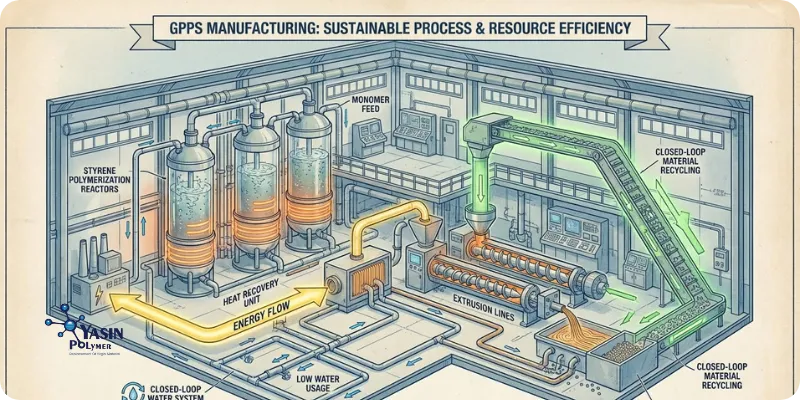
Lifecycle Assessment (LCA) of GPPS and EPS Materials
To truly understand the environmental footprint of General Purpose Polystyrene (GPPS) and Expanded Polystyrene (EPS), we must look beyond the recycling bin. This guide translates dense scientific Lifecycle Assessment (LCA) data into actionable business intelligence. We analyze the complete “Cradle-to-Grave” journey from oil extraction to final recovery—comparing these materials against alternatives like paper and glass to reveal the data-backed reality often missed in public discourse.
What is Lifecycle Assessment (LCA) for Polystyrene?
Lifecycle Assessment (LCA) is the standardized scientific method used to quantify environmental impacts across every stage of a product’s life. Without defined boundaries, sustainability claims are often meaningless. To ensure a fair comparison, we adhere to three core concepts:
-
Cradle-to-Gate: This measures the impact from raw material extraction (oil/gas) up to the moment the material leaves the factory (Manufacturing).
-
Cradle-to-Grave: This includes everything in the gate phase plus distribution, usage, and final disposal (Recycling, Incineration, or Landfill).
-
Functional Unit: This is critical for accuracy. We do not compare materials by kilogram, but by function. For example, we measure the impact of “packaging required to protect 1kg of food.” Because plastic is lighter, comparing by simple weight often skews data against heavier, yet sometimes less efficient, alternatives.
What is the Difference Between GPPS and EPS?
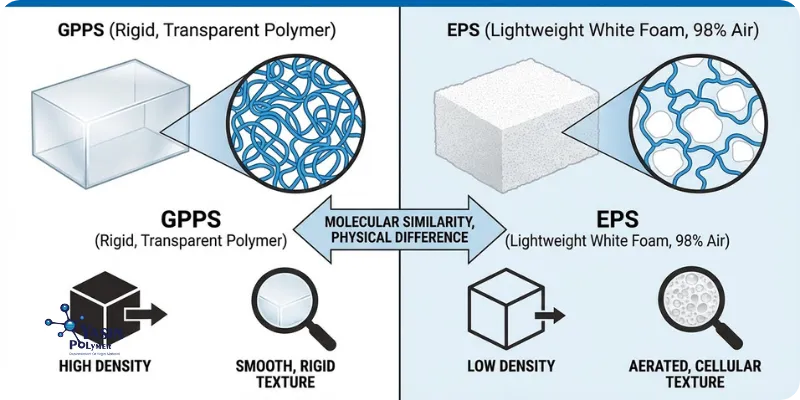
While both materials originate from the same styrene monomer, their physical forms, applications, and environmental footprints differ significantly.
-
GPPS (General Purpose Polystyrene): This is the rigid, clear, glass-like form of the polymer. It is dense and primarily used for items requiring transparency and rigidity, such as refrigerator trays, CD cases, and food containers.
-
EPS (Expanded Polystyrene): This is the foam version, consisting of roughly 98% air. Its lightweight nature makes it the standard for insulation and protective packaging.
| Feature | GPPS (Rigid) | EPS (Foam) |
| Structure | Solid, transparent pellet/sheet | Cellular foam, white beads |
| Density | High | Very Low (98% Air) |
| Primary Use | Food packaging, lab ware | Thermal insulation, shock absorption |
How Does GPPS Production Impact the Environment?
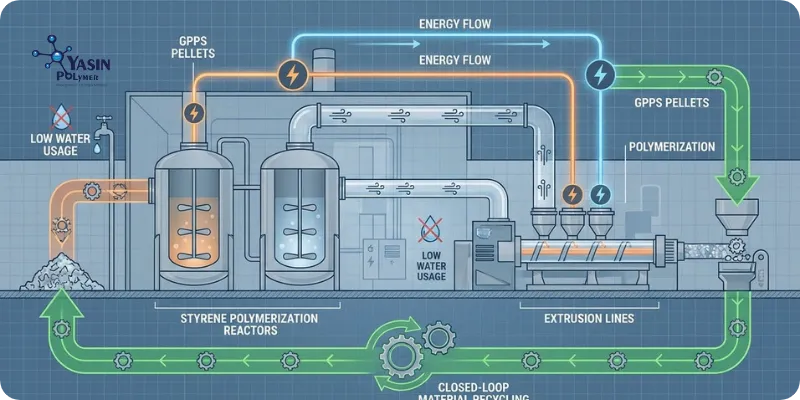
The manufacturing of GPPS is an energy-intensive process, yet highly efficient regarding material waste. The primary environmental burden during the “Cradle-to-Gate” phase is the Cumulative Energy Demand (CED) required to polymerize styrene into solid pellets using heat and pressure.
Because the feedstock is derived from fossil fuels, the GPPS manufacturing process has a carbon footprint tied to oil and gas extraction. However, the extrusion process itself is incredibly efficient. Unlike other materials where trimming creates waste, GPPS off-cuts and scraps in the factory are almost immediately re-melted and re-extruded, resulting in near-zero material waste during production. Furthermore, compared to the melting of glass or the smelting of aluminum, GPPS production consumes significantly less water.

Why Does EPS Often Score Better Than Paper in LCAs?
A common misconception is that paper is always the sustainable choice. However, when strictly analyzing data regarding logistics and resource consumption, EPS often outperforms paper and cardboard, primarily due to weight.
The Water vs. Carbon Trade-off
Because EPS is 98% air, it is exceptionally lightweight. This drastically reduces fuel consumption and transport emissions compared to heavy cardboard alternatives. While plastic has a carbon footprint derived from its fossil fuel origin, paper production is resource-heavy in other areas. Paper mills consume massive amounts of water and chemicals during the pulping process. In many LCA studies, when the “Water Usage” and “Transportation” metrics are weighted heavily, the efficiency of lightweight EPS creates a lower overall environmental load than the heavier, water-intensive production of cardboard.
Does EPS Insulation Save More Energy Than It Consumes?
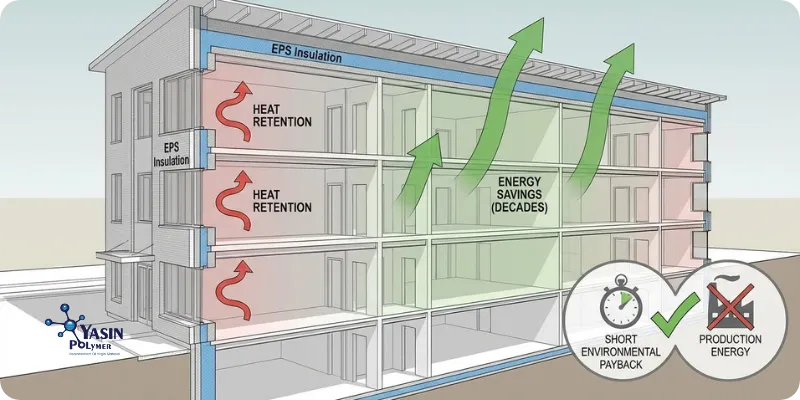
For construction applications, focusing on the production cost of EPS misses the bigger picture. The true value lies in the “Use Phase.” The energy required to produce EPS insulation is miniscule compared to the massive energy savings it generates over a building’s lifespan.
This is defined as the Environmental Payback Period. For high-quality EPS insulation, the time required to save the energy equivalent to its production cost is often just a few months. Over a typical 50-year building lifespan, that same insulation prevents tons of CO2 emissions by drastically reducing the load on heating and cooling systems. In this context, the environmental ROI of EPS is overwhelmingly positive.

What Are the End-of-Life Scenarios for Polystyrene?
The “Grave” phase of the lifecycle is historically the most challenging for polystyrene. We must transparently analyze the three main disposal paths:
-
Landfill: Polystyrene is inert. While it does not biodegrade, it also does not rot or release methane (a potent greenhouse gas) like paper or food waste. Its primary negative impact here is volume; it takes up space permanently.
-
Incineration (Energy Recovery): PS has a high calorific value, similar to fuel oil. Modern waste-to-energy plants can burn it to generate electricity. While this recovers energy, it releases the embodied carbon as CO2.
-
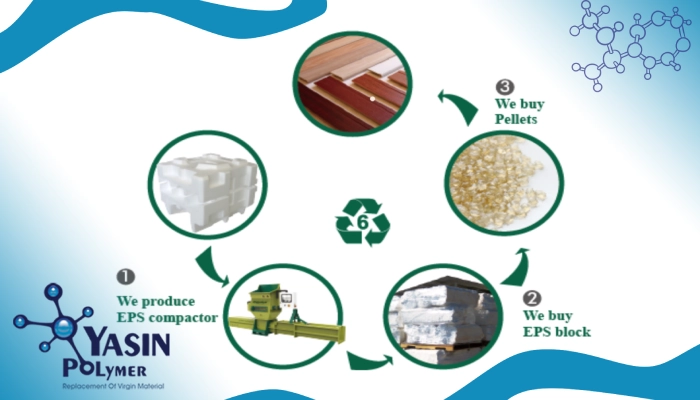
Mechanical Recycling: This involves grinding and re-melting GPPS or compressing EPS. It is effective but requires clean, sorted waste. The challenge with EPS is logistics; collecting and transporting material that is mostly air is rarely cost-effective without densification equipment.
How Does Chemical Recycling Change the LCA Results?
Advanced technology is currently rewriting the LCA score for polystyrene. Chemical recycling, specifically depolymerization, addresses the limitations of mechanical recycling. Unlike mechanical grinding which can degrade the material, this process breaks the molecular bonds of the waste plastic.
The Advanced Recycling Loop:
-
Collection: Dirty or mixed PS waste is collected.
-
Depolymerization: The plastic is broken down into its original liquid form.
-
Distillation: Contaminants are removed, purifying the liquid.
-
Creation: The liquid is re-polymerized into “virgin-quality” GPPS or EPS.
This is a game-changer because it allows recycled styrene monomer to be used for food-contact applications—something mechanical recycling rarely achieves—creating a true circular economy.
GPPS vs. EPS vs. Alternatives
The following table provides a direct comparison of environmental trade-offs across common packaging materials.
| Material | Primary Impact (High) | Primary Advantage (Low Impact) | Recyclability Potential |
| GPPS | Fossil Fuel Depletion | Low Water Use | High (Chemical/Mechanical) |
| EPS | Landfill Volume | Very Low Transport Emissions | High (If compressed) |
| Paper/Cardboard | High Water & Land Use | Low Fossil Fuel Use | High (Often downcycled) |
| Glass | Very High Transport Energy | Reusable / Inert | High (Infinite) |
Conclusion
The Lifecycle Assessment (LCA) of GPPS and EPS makes one point unmistakably clear: sustainability cannot be judged by weight, appearance, or end-of-life alone. Both materials—especially EPS—deliver significant efficiency advantages in packaging and construction when assessed across their full cradle-to-grave journey. Their light weight reduces transport emissions, GPPS manufacturing uses comparatively little water, and EPS insulation returns far more energy savings than it consumes during production. With the emergence of chemical recycling, long-standing end-of-life limitations are rapidly improving, enabling true circularity for polystyrene. Ultimately, material selection should be driven by function and verified LCA data—not assumptions or public perception.
FAQ
1. Are EPS and GPPS always worse for the environment than paper products?
Not necessarily. Many LCAs show that EPS and GPPS can outperform paper due to lower transport emissions, lower water usage, and more efficient resource consumption in specific applications.
2. Why does EPS sometimes score better than cardboard in LCA studies?
Because EPS is about 98% air, making it extremely lightweight. This dramatically reduces fuel use and emissions during transportation, often outweighing the heavy water and chemical consumption required for paper production.
3. Can polystyrene actually be recycled?
Yes. GPPS can be recycled mechanically or chemically, and EPS becomes highly recyclable when it is compressed or densified. Chemical recycling is especially impactful because it produces virgin-grade material suitable for food contact.
4. Does EPS insulation really save more energy than it takes to produce?
Absolutely. The energy used to manufacture EPS insulation is typically recovered within a few months through reduced heating and cooling loads, and over a building’s lifetime the energy savings are many times greater.